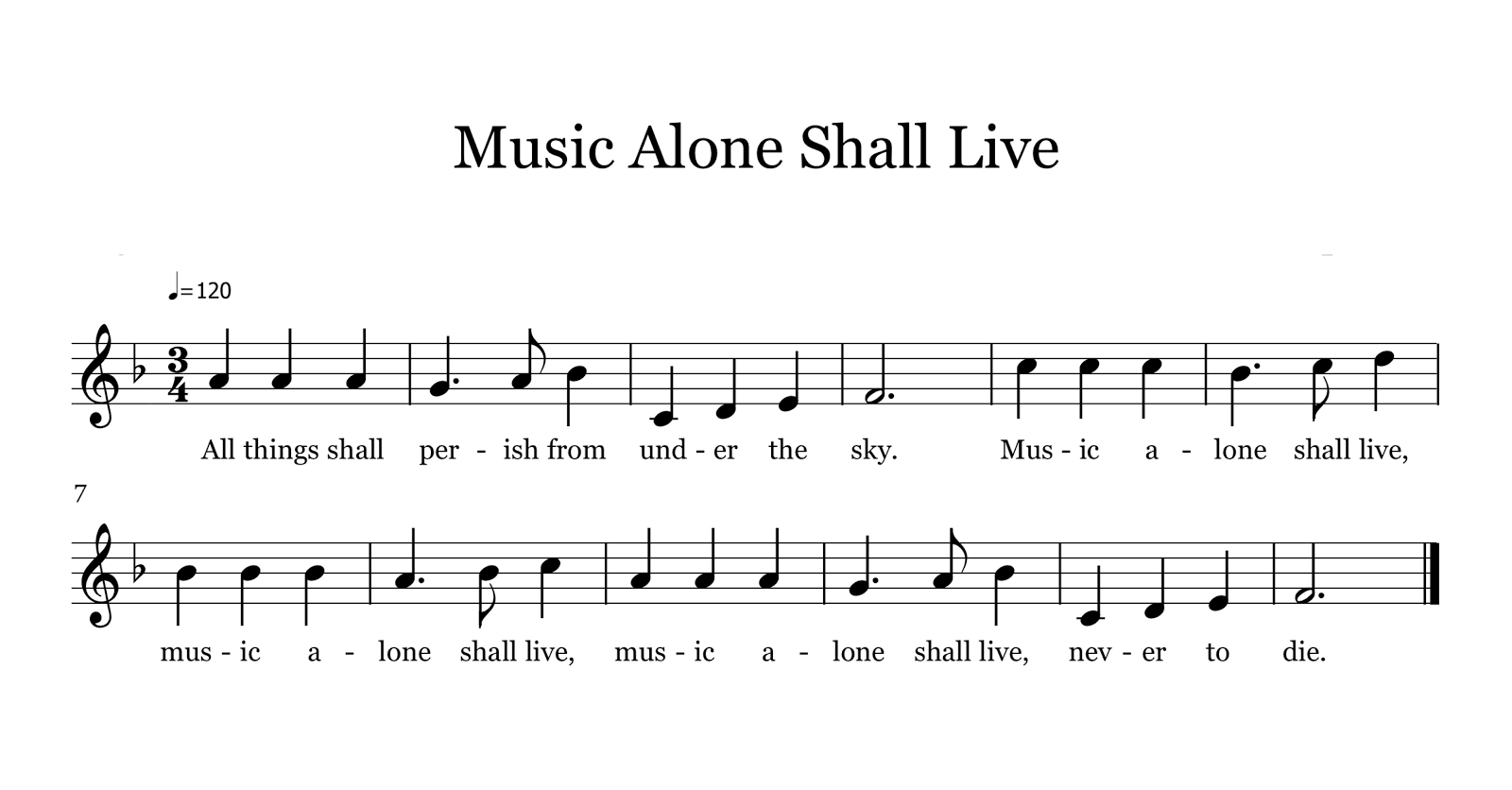
Music Alone Shall Live Lesson Ideas and Activities

Music Alone Shall Live is a German Folk Song and is based on a German Canon called Die Musici. This diatonic piece works well for singing in a round or playing on pitched percussion instruments. There are also several different choral arrangements for this piece, which you might consider for future concerts.

SINGING IN ROUND

This German folk song provides beautiful harmony when sung in a round. It’s also a good opportunity to discuss musical form with your general music class or elementary choir. Here are a few things I always kept in mind when teaching students to sing in a round:

  • If they can’t sing the song independently in unison (without you singing along), then they won’t be able to sing it confidently in a round on their own.
  • Students will experience the most success when they work on small portions of the song over a long period of time (several class periods), rather than trying to learn the whole song in one class period.
  • Finding new ways to experience a song will keep students from disengaging during a repetitive practice. For example, instead of just singing the same measures over again, students could sing the section while moving their arms to show the phrasing. Or you could pass around a hand bell for students to chime on your cue. You could even have them march to the beat around the room as they sing it. Anything to distract them from the fact that they’ve sang the same section four times in a row.
  • The look on their faces when they experience their own harmony for the first time is always worth the wait!

For an added challenge, they can try singing it in German.

The following video is a good visual representation of singing in a round. Note to the students that she is dressed the same each time she sings, just like each vocal part is the same, but comes in at different times.

INSTRUMENTS

Due to its mostly step-wise motion, I think this piece is great for pitched percussion. You could try it with Boomwhackers™, Orff instruments, or handbells. I also think this would be a gorgeous piece for a handbell choir.
I recently upgraded to Noteflight Premium during their Cyber Monday deal. I was pretty excited about it, so I had to incorporate one of the new features into today’s blog post, colored notation!
I taught myself how to play piano, beginning with my grandmother’s color-notated music textbook. So, I’m a big fan of using color-coded notes in the music classroom. As one of my mentors once told me, “Use whatever works.” If it works for you and your kids, then go for it!
If you end up using my color-coded notation of this song, I’d love to hear about it. Please leave a message in the comments about how you plan to use it or any other ideas you might have for this piece. As always, I look forward to hearing from you!

Want free resources and practical lesson ideas in your inbox every month? Sign up, and I’ll send you my Music Sub Cheat Sheet right away.

2 Responses

  1. Oh perfect, thank you for including the color-coded notation! I love using color-coding to match boomwhackers when the students are doing melodic composition or working in small groups/ centers. This would be a great one because it uses all of the notes! And I love the pronunciation guide for the different languages!