Picture it. It’s your first week back to school. Your carefully curated sub tub is ready to go along with a folder that contains all the details a sub needs to survive the day. You even created a sub-friendly guide on how to work all the tech in your room. You’re proud of how prepared you are this year, and you hope your sub appreciates all your efforts.
In walks your sub, someone who’s never taught music a day in their life. Upon entering your classroom, they see a huge tub of materials, a folder filled with details on the 500 students they’ve never met, and lesson plans that involve singing. They pause on the word singing.
Suddenly, the words they heard as a kid come flooding back. “You can’t sing. You just don’t have the talent.” They become paralyzed with fear, and instead of following your carefully crafted plans, they fall back on what’s familiar. They play a few kids games they know, read a random book from your shelf in the back, and let the students play any instrument they grab. They figure, at least the kids are doing something musical.
This is where the substitute cheat sheet comes into play.
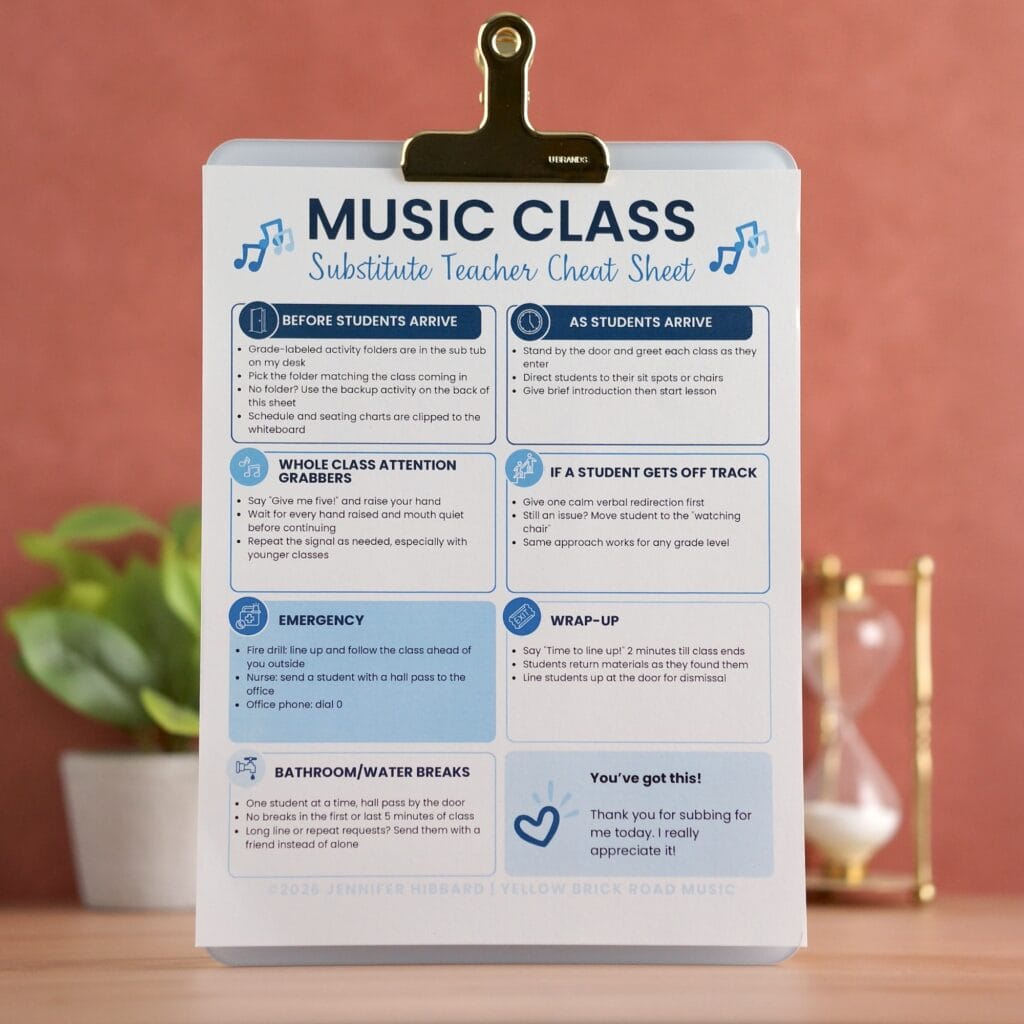
The substitute cheat sheet shows subs exactly what they need to know, all in one sheet that they can reference throughout the entire day. It provides the broader context too, so they see the general flow of your classroom before having to go over all the details in your lesson plans and expectations.
The substitute cheat sheet is not meant for the finer details. In fact, if you try to include more details than is necessary, the cheat sheet will lose its effectiveness, and the sub will once again fall back on what’s most familiar to them. Click the download button below to download the PDF and customize it for your classroom.
Want more freebies like this? Join my newsletter, and I’ll send one that fits the season once a month.
Example Text You Can Use
To help you get started on your own, here’s the example text I used in the image above:
Before students arrive
- Grade-labeled activity folders are in the sub tub on my desk
- Pick the folder matching the class coming in
- No folder? Use the backup activity on the back of this sheet
- Schedule and seating charts are clipped to the whiteboard
As students arrive
- Stand by the door and greet each class as they enter
- Direct students to their sit spots or chairs
- Give brief introduction then start lesson
Whole class attention grabbers
- Say “Give me five!” and raise your hand
- Wait for every hand raised and mouth quiet before continuing
- Repeat the signal as needed, especially with younger classes
If a student gets off track
- Give one calm verbal redirection first
- Still an issue? Move student to the “watching chair”
- Same approach works for any grade level
Emergency
- Fire drill: line up and follow the class ahead of you outside
- Nurse: send a student with a hall pass to the office
- Office phone: dial 0
Bathroom/Water Breaks
- One student at a time, hall pass by the door
- No breaks in the first or last 5 minutes of class
- Long line or repeat requests? Send them with a friend instead of alone
Wrap-up
- Say “Time to line up!” 2 minutes till class ends
- Students return materials as they found them
- Line students up at the door for dismissal
Sub Lessons
The cheat sheet points your sub to grade or class-labeled activity folders, so those folders need lessons any sub can teach (musically trained or not). If you’re still working on yours, take a look at my No Prep Activities for Elementary Music. It has 50+ videos with matching worksheets, so your students still get a real music lesson, even with a sub who’s never taught music a day in their life. For older grades, No Prep Activities for Music has 27 sub lessons with matching worksheets.