Listening with Purpose
Passive listening has its place in our lives. If you’re anything like me, you passively listen to music to make an annoying chore less torturous or as background noise to the dumpster fire that is any given year. While passive listening certainly has its purpose, it requires no reaction or deep thought by the listener. Conversely, music teachers work hard to create an environment that nurtures active listening.
Active listening requires focus, purpose, and the intention to learn something new. For example, instead of asking students to “listen to this piece of music by Florence Price,” music teachers can ask, “Did the dynamics change during the Andante? If so, how did they change? How did the dynamics make you feel?” These are the types of questions that encourage students to listen with purpose.
Active Listening Questions
Here’s a general list of questions (organized by element) to help guide your students in their active listening:
Timbre
- What instruments did you hear?
- How many instrument families did you identify?
- How did the instruments blend together? Did you hear one instrument more than another?
- How would you describe the timbre of those instruments during this section?
- Was the timbre piercing or mellow? If mellow, how did that make you feel?
Dynamics
- Did the dynamics change or stay the same?
- What was the most surprising dynamic change in this piece?
- Why do you think the composer chose to have a soft dynamic during this section?
- How did that surprising dynamic make you feel?
Tempo
- Did the tempo change or stay the same?
- Was the tempo fast, slow, or medium?
- Did the tempo make you want to get up and dance? Why?
- How did the fast tempo make you feel?
Rhythm
- Were the notes short and separated or long and connected?
- Did you hear any syncopation?
- Were the instruments all playing the same rhythms?
- Did you hear any rhythms that were repeated?
- What kind of mood did the short and separated notes help create?
Pitch
- Did you hear a melody that repeated in this music?
- Did you hear lots of step-wise motion or leaps and octaves?
- Was the melody memorable? If so, was it because of repetition or something else?
- Did the melody feel haunting or joyful? Why?
Texture
- Were the instruments playing the same rhythms and pitches?
- How many different motives did you hear in this piece? Did they all occur simultaneously?
- Was the texture thin or thick? Why?
- How did the lengthy rests affect the texture of this piece?
- Why do you think the composer chose to include so many instruments and voices? How did it make you feel?
Harmony
- Did you hear harmony in this piece? Who or what created it?
- Did you hear any dissonance? How did it make you feel?
- Why do you think the composer included dissonance in this section?
- Did you hear a key shift in this piece? How did it affect the harmony?
Form
- Was this piece in binary or ternary form? How can you tell?
- How many sections did this piece have? Were they all the same?
- Did the music begin and end with the same section?
- What was similar about each section of the music?
- Did you like it when this section repeated? Why?
Student Connections
It’s important that students can connect the music to themselves in one way or another. There are several ways to do this:
- Let them choose the music
- This is a simple way to ensure that students are connecting with the music they hear
- It’s also a great way to build relationships and learn more about your students
- Ask students how the music made them feel
- Music is all about feelings; whether it’s a deep emotional response to a melody or the feeling of pride that comes from a rich cultural heritage
- Asking students how they feel about music is an easy way to connect with them on a deeper level
- Focus on expression and ideas, not right or wrong
- Students are told what to do all day long; when to eat, when to stand up, when to go to bed. No doubt they can begin to feel like nameless cogs in a wheel. So imagine how they feel when adults want to know their opinion on music. Just because. Imagine their response when you hear their ideas and say, “I never thought of it that way. I love the way you think!” or “I’m so glad you noticed that. That’s my favorite part too.”
Ultimately, active listening is about teaching students to understand and articulate their own feelings and observations about the music they hear. The ability to do that comes with time, practice, and a judgment-free environment.
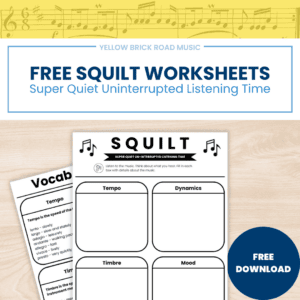
Free Active Listening Worksheets
Use my free SQUILT sheets to help guide your students in their active listening practice. You can also use them paired with a specific piece as a quick and easy sub plan!