Classical Rhythm Patterns – 20th and 21st Century Music: Modern Period Composers

(5 customer reviews)
Category: Topic: Grade Level: Concept: Type: Formats: , ,

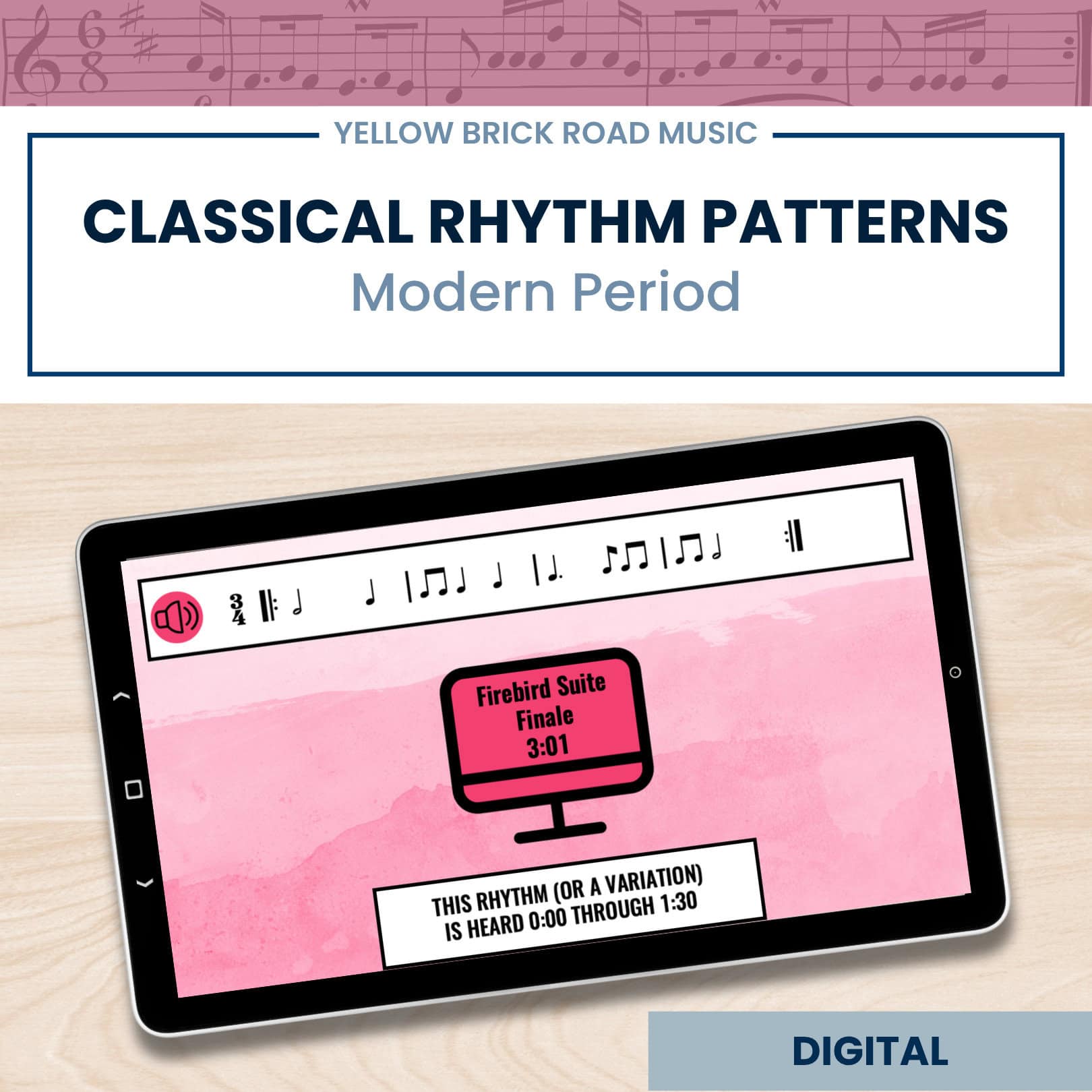
This interactive slideshow helps students practice reading rhythms while they hear music by composers from the 20th and 21st centuries. Each slide shows a rhythm pattern from a real piece, and students can sight-read it, then play the audio to check. It works in band, choir, orchestra, and general music classes.

What’s included

  • An interactive slideshow with a clickable menu
  • 20 rhythm patterns, from half notes to sixteenth notes and dotted notes
  • Audio of each rhythm in a real piece of music, with time stamps
  • Directions and ideas for use

Composers and pieces

  • Dame Ethel Smyth: “The March of the Women”
  • Ralph Vaughan Williams: English Folk Song Suite
  • Gustav Holst: “Thaxted” from Jupiter
  • Igor Stravinsky: The Firebird Suite, Finale
  • Florence Price: Juba Dance
  • Sergei Prokofiev: Peter and the Wolf: The Cat
  • William Grant Still: Symphony No. 1, Animato
  • George Gershwin: “I Got Rhythm”
  • Duke Ellington: “It Don’t Mean a Thing”
  • Aaron Copland: “Simple Gifts”
  • Dmitri Shostakovich: Waltz No. 2
  • Benjamin Britten: “Cuckoo”
  • Leonard Bernstein: “Mambo”
  • John Williams: “The Imperial March”
  • Philip Glass: Metamorphosis One
  • Tania León: “Alegre”
  • Valerie Coleman: Umoja
  • Jennifer Higdon: Rhythm Stand
  • Eric Whitacre: “Fly to Paradise”
  • Astor Piazzolla: “Libertango”

Formats

  • PDF
  • Google Slides: A link is included in your download and lets you add your own copy to Google Drive.
  • PowerPoint

Important

  • Videos play through YouTube, so an internet connection is required.
  • The slideshow must be in presentation mode for the audio and video clips to work.

Ways to use it

  • Sight-read one rhythm, then play the audio to check
  • Cover the time stamps and have students find when, or how often, the rhythm happens in the piece
  • Have band and orchestra students play the rhythm on one note or with a certain articulation
  • Focus on one composer each week, with students sharing facts or a playlist of their music
  • To learn more about each composer, pair it with the Modern Period Quick Guide.

Standards (NCAS)

  • Performing: Anchor Standard 4 (select, analyze, and interpret artistic work for presentation)
  • Responding: Anchor Standard 7 (perceive and analyze artistic work)
  • Connecting: Anchor Standard 11 (relate artistic ideas and works with societal, cultural, and historical context)

License & help

This purchase is for one teacher to use with their own students. Each teacher needs their own copy. See the full terms of sale →

Questions about downloading, printing, or Google Slides? Visit the FAQ →
$7.00

Products Included in This Bundle:

5 reviews for Classical Rhythm Patterns – 20th and 21st Century Music: Modern Period Composers

  1. Amy O. –

    I like the way the rhythms encourage connections to the classics. Thanks!

    • Yellow Brick Road Music –

      Thanks for the review!

  2. davina A. –

    I really enjoy this resource. It’s an easy and fun way to introduce classical music and practice rhythm at the same time

    • Yellow Brick Road Music –

      Thanks!

  3. Yvonne G. –

    So far my students have loved listening to and watching the videos of the musicians playing their instruments. This has created a lot of discussion and sparked an interest in the various musical pieces and instruments played. Thank you.

    • Yellow Brick Road Music –

      I’m so happy to hear that Yvonne! There’s nothing better than a passionate discussion on music in the classroom 🙂

  4. Kelley Fewer –

    This is a great value- full of good resources and lots of activities that the students really enjoyed.

    • Yellow Brick Road Music –

      Thanks!

  5. Kathleen H. –

    This resource is amazing! Thank you, Jennifer for going to all this work! My students can read rhythms but not always play them, and hearing the notated rhythms in the music really helped them internalize the rhythms. We have used “It Don’t Mean a Thing” because we had learned the song already. We read the rhythm with the notation, tried to play it on our own. Then we listened to the music, then played it with the music on sticks/drums, then played it on our own again. The students really felt proud of themselves with these steps. Next we will use the Vaugh-Williams March. There are some I can use for my younger students as well. What an excellent resource! I highly recommend this, as I do all of Jennifer’s work!

    • Yellow Brick Road Music –

      Thank you Kathleen! I’m incredibly grateful that you took the time to leave such a thorough review. I’m so glad that your students felt proud of themselves after playing one of the rhythm patterns. It sounds like you have a great learning sequence going with them!

Add a review

Your email address will not be published. Required fields are marked *